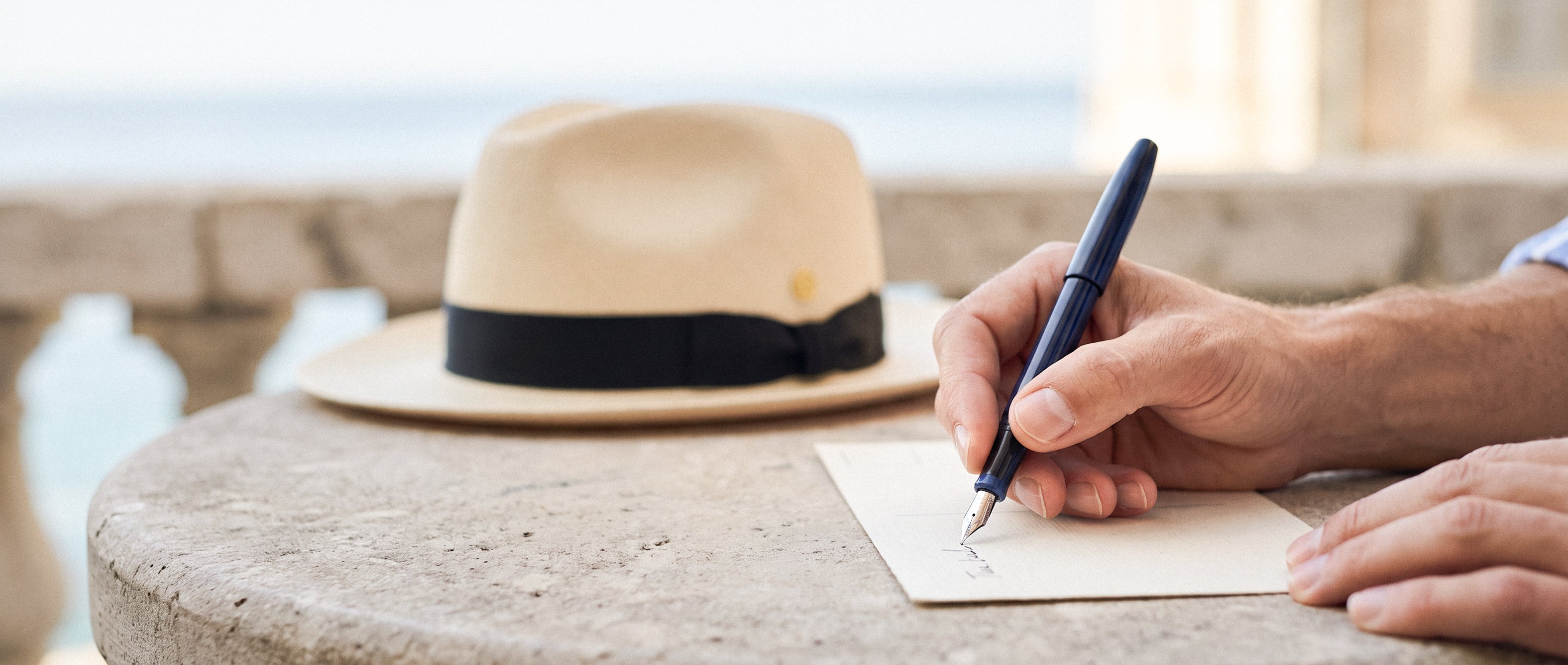
What hats do Italian men wear in summer? Mostly straw: a panama, a narrow-brimmed straw fedora or trilby, a linen or cotton coppola — the Sicilian flat cap — and, for weddings and regattas, the paglietta, which Americans know as the boater. The shapes are familiar. The proportions are not: Italian summer hats run shorter in the crown and narrower in the brim than their American counterparts, in natural colors chosen to sit quietly beside linen tailoring.
That restraint is the whole trick. An Italian summer hat is rarely the loudest thing a man is wearing, and it is almost never bought for a single occasion. Since 1911, JJ Hat Center has been fitting New Yorkers in Italian straw, and the hats that cross the Atlantic best are the quiet ones.
What Hats Do Italian Men Wear in Summer: The Four Staples
Four shapes cover nearly everything you will see between Naples and the Dolomites once the heat sets in:
- The panama. Woven in Ecuador from toquilla palm, blocked and finished in Italy. The dress straw — worn with tailoring, worn in town.
- The straw fedora or trilby. Toyo, hemp, raffia or sisal, with a crown creased like a felt hat and a brim cut close. The everyday brimmed hat.
- The coppola. The flat cap, made up for summer in linen, cotton or a silk blend instead of winter tweed.
- The paglietta. The stiff sennit boater, kept for weddings, boat clubs and the occasional deliberately old-fashioned Sunday.
The split between brimmed hats and caps is closer than most Americans expect. Across a full year on our floor, caps and brimmed hats together account for roughly three quarters of everything we sell, and the cap half is no sideline. In the last three months alone, a linen trilby and a linen summer flat cap both landed among our ten best-selling pieces — the same two-track summer wardrobe an Italian man keeps by the door.
What Makes a Hat an Italian Hat?
It is rarely the raw material. The toquilla palm comes from Ecuador, toyo paper straw from East Asia, raffia from Madagascar. What makes an Italian hat is everything that happens after the body arrives: the block it is pulled over, the height of the crown, the width of the brim, the weight of the ribbon, and the decision to stop there.
Borsalino, founded in Alessandria in Piedmont in 1857, set that grammar and still keeps it. Stand an Italian-blocked summer hat next to an American one and the differences are small and consistent: a crown nearer four inches than five, a brim nearer two and a half inches than three, a narrow grosgrain ribbon in a tone close to the straw instead of a contrasting band. The hat frames the face; it does not announce itself from across the piazza.
That discipline is also why the label travels. Borsalino sits third by volume among the brands we sell, behind two much broader everyday labels, and roughly one in eight of the shopping clicks our brands draw lands on it. If you want the shorthand version of Italian summer style, our Italian style collection built around Borsalino is the clearest place to start, and the full Borsalino range shows how the same proportions carry from straw into felt.
The Panama: Ecuadorian Straw, Italian Finish
The panama is the dress hat of the Italian summer, and it is not from Panama. The bodies are hand-woven in Ecuador, chiefly around Montecristi and Cuenca; the name stuck because the hats were shipped through Panama and worn by men digging the canal. Italian hatmakers buy the woven bodies and do the rest at home — blocking, trimming, sizing, finishing.
What you are paying for is weave. A coarse weave takes days; a fine one takes weeks or months, and the result is lighter, more supple, and far more even when you hold it against the sky. A fine panama also behaves better in the sun, because the closer weave shades without feeling like a board on your head. If you want the full picture of how the body gets made before Italy ever touches it, we wrote it up in how a panama hat is made.
Two practical points before you buy from our panama hat collection. First, only roll a panama if it was sold as rollable — a standard blocked panama will crack along the fold. Second, buy it in natural or ivory if it is your only one. Bleached white looks brittle after a season, and dark straw absorbs heat you spent good money to avoid.
The Straw Fedora and Trilby: Why the Italian Brim Is Narrower
Below the panama in formality, and far ahead of it in daily use, sits the creased straw hat. The trilby is the tighter of the two: a shorter crown, a brim of an inch and a half to two inches, snapped down at the front and turned up sharply at the back. The fedora keeps a taller crown and a wider, more flexible brim.
Italian men lean trilby in summer for reasons that have nothing to do with fashion cycles. A narrow brim clears the shoulders in a crowded street, it does not fight sunglasses, and it stays on a hook indoors without taking up a chair. The trade-off is coverage: a two-inch brim shades a face, not a neck. If you spend the afternoon outside, take the wider fedora brim and accept the extra presence — our guide on how to wear a fedora covers the proportion question in detail.
Material decides character more than shape here. Toyo, a paper straw, is crisp, holds a sharp crease and keeps its line in humidity. Hemp braid is softer and matte, closer to a linen shirt than to a dress hat. Raffia is the most casual and the most forgiving in a suitcase. Sisal sits in between, with a tighter surface that takes a formal ribbon well. You can see the range side by side in our straw hat collection.
The Coppola: The Italian Cap Made for Summer
The coppola is the Sicilian flat cap, and in Italy it is the most-worn head covering of all — on farmers, on architects, on men who would never put on a brimmed hat. The winter version is wool tweed. The summer version is the same pattern cut in linen, washed cotton or a linen-silk blend, usually unlined, with the crown panels trimmed down so the cap lies flat rather than ballooning.
The distinction worth knowing: a true coppola is the one-piece flat cap with a short stitched peak. The fuller, eight-panel cap with a button on top is the newsboy, and it drinks far more fabric — which in July you feel. If you want an Italian cap that works in real heat, take the flat one-piece in linen and leave the newsboy for October.
Linen also handles sweat better than wool does. It takes on salt at the band, but it dries quickly and airs out overnight if you park the cap brim-up on a shelf instead of folding it into a pocket. A wool cap worn through an American August rarely recovers that gracefully.
The Paglietta: The Boater, and When It Still Works
The paglietta is stiff sennit straw with a flat top, a flat brim and a wide ribbon — the hat on every Venetian gondolier and, historically, on half the men at any Italian summer regatta. It is the one Italian summer hat that reads as a costume if the rest of the outfit does not earn it.
It earns it at a summer wedding, at a boat club, at any daytime event with a dress code. It does not earn it with shorts. If you want one hat that spans the whole season, this is not that hat; if you already own the panama and want something with a genuine sense of occasion, it is the obvious second.
Straw, Linen or Cotton? Choosing the Material for Real Heat
Three variables decide whether a summer hat is pleasant to wear in August: airflow, shade and weight.
- Open-weave straw moves air across your scalp and lets light through. Coolest to wear, least protective in direct midday sun.
- Tight-weave straw — a fine panama, a good toyo — blocks more sun and stays cooler than any fabric of the same coverage, because the straw itself does not hold heat.
- Linen and cotton caps breathe well and pack flat, but a peak shades your eyes and nothing else. For a full day outdoors, a brim wins.
Weight matters more than it sounds. A summer hat you notice on your head after an hour is the wrong hat, and the usual culprits are a heavy sweatband, a fully lined crown, or a brim wired stiff enough to fight the wind. Pick the hat up before you judge the price: the good ones feel like almost nothing.
How to Choose Among Men's Italian Hats: Fit, Proportion and Color
Fit first, because straw does not forgive
At JJ Hat Center, a New York hat shop trading since 1911, straw is fitted on the head rather than ordered off a chart, and the reason is simple: felt can be stretched and eased by a hatter, and straw cannot — not meaningfully, and not without risking the weave. A straw hat has to fit when you buy it: snug enough to stay put in a breeze, loose enough to leave no red line across your forehead after twenty minutes. American sizes run in eighths of an inch, so a man who wears a 7 1/4 in a felt fedora should try the 7 1/4 and the 7 3/8 in straw and take whichever sits level without pressure at the temples. Italian and other European makers mark their sweatbands in centimeters instead; any hatter can convert it, and our staff does it daily.
Proportion, not trend
Brim width reads against shoulder width. A narrow brim on a broad frame looks undersized; a wide brim on a slight one wears the man. Crown height works the same way against face length — a long face carries a taller crown, a round one is better served by a lower crown and a slight taper. If you are unsure, the Italian answer is the middle: a crown of about four inches and a brim of two to two and a half inches flatters most people.
Color, and why natural wins
Natural, ecru and light tobacco go with every shade of linen, denim and cotton an American summer wardrobe contains. Bleached white is unforgiving and ages fast. Black straw is a specific, evening-leaning choice — it looks sharp, and it gets hot. If it is your first Italian summer hat, take the natural one; the second can be the statement.
How Italians Actually Wear Them
The rules are unwritten and fairly consistent:
- Level, not pushed back. The brim sits roughly parallel to the ground, the front edge about a finger's width above the eyebrows. Tipped back is American casual; tipped forward is film noir. Neither is Italian.
- One statement per outfit. If the hat has a patterned band, the shirt does not have a pattern. If the jacket is loud, the hat is natural straw and nothing else.
- Match the formality of the shoes. Panama with loafers and tailoring; straw trilby with anything; coppola with sneakers, chinos and short sleeves. A boater with sandals is a joke the wearer is not in on.
- No logos. Italian hat branding lives inside the sweatband, not on the crown.
One more habit worth copying: they take the hat off indoors and they do it without ceremony, holding it by the brim edges rather than pinching the crown. Pinching is what wears the crease through on a straw hat, and it is the single most common way a good summer hat dies before its third season.
Keeping a Summer Straw Hat Alive
Straw is a natural fiber that dries out, and heat is what kills it. Never leave a hat on the rear shelf of a parked car — that is an oven, and the crown will warp out of block. Store it crown-down on a flat surface or in a box, never resting on the brim, which is where the shape goes first.
Sweat salt at the band is normal; blot it with a barely damp cloth and let the hat air dry away from direct sun. Dust comes off with a soft brush, working around the crown in one direction. A brim that has gone slightly wavy can often be coaxed back with steam held at a distance and gentle pressure while the straw is warm, but a cracked weave is permanent — which is the real argument for buying one good hat rather than three indifferent ones.
Frequently Asked Questions
What hat do Italian men wear with a linen suit?
A panama in natural or ivory, with a narrow ribbon matched close to the straw. It is the one combination that is effectively never wrong at a summer wedding, a lunch or a day at the races. A fine straw fedora in a neutral tone is the informal alternative.
Is a panama hat actually Italian?
No. Panama hats are woven in Ecuador from toquilla palm. Italian houses buy the woven bodies and block, trim and finish them, which is why so many of the best panamas carry Italian names. The weave is Ecuadorian; the shape and the finish are Italian.
What is an Italian cap called?
The coppola — the one-piece flat cap associated with Sicily and worn across Italy. In summer it is made in linen or cotton rather than the tweed used from fall onward.
Is there an Italian hat for women, or are these menswear shapes?
Panamas, straw fedoras and coppolas are all worn by Italian women, usually in the same blocks and sizes; an Italian hat for women is more often a question of fit and brim width than of a separate shape. Women's straw hats simply extend further into wide-brim territory, where a man's summer hat generally stops.
How much should a good Italian summer hat cost?
Enough that the weave is even and the hat feels like nothing on your head. A well-made toyo or hemp straw is an accessible everyday hat; a fine hand-woven panama sits in another bracket entirely, because it represents weeks of someone's work. Both cost less per summer than replacing a poor hat every year.