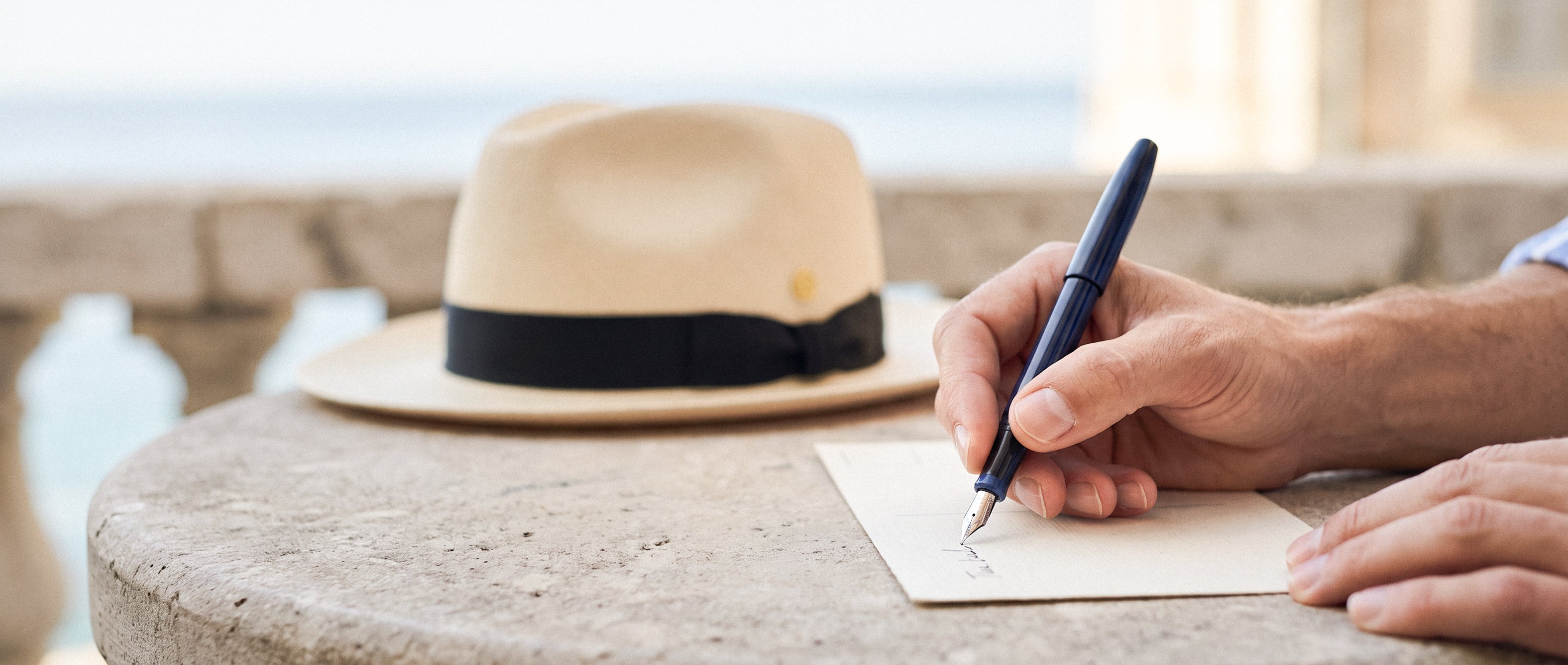
What is a rain hat? It is a hat made from a water-shedding material — waxed cotton, oilskin-treated leather, coated cloth, or water-repellent wool felt — and shaped so the brim carries water away from your face and collar instead of into them. A rain hat is not simply the hat you happen to be wearing when the sky opens: its finish makes water bead and run off, its brim slopes far enough to shelter your eyes, and it comes back to its own shape once it dries.
Since 1911, JJ Hat Center has fitted New Yorkers for weather that arrives without warning. The question we hear most often in a wet October is a practical one: which hat will still look like a hat after a soaking? The answer comes down to three things — material, brim, and how you dry it.
What Is a Rain Hat? Three Things That Define One
Plenty of hats survive a light shower. What earns the name is the combination of all three of the following.
A finish that works on the surface. Rain protection in a hat is almost always a surface property, not a sealed barrier. A wax finish, an oiled leather, or a resin-coated cloth changes how water behaves the instant it lands: instead of soaking into the fibers, it beads and rolls off. That is why a waxed cotton hat can be made of the same cotton as a summer cap and behave completely differently in a storm.
A brim with somewhere for the water to go. Water follows the shape you give it. A brim that slopes down at the front sheds rain ahead of your face; one that flares up delivers it straight down your neck. This is the single most overlooked part of buying a rain hat, and the reason a cap and a hat perform so differently in the same downpour.
Construction that survives getting wet and drying out. A hat that gets soaked has to dry without shrinking, warping, or leaving a tide line. That means a sweatband that can be turned out to dry, a lining that does not pucker, and a body stiff enough to hold its shape while damp. Our rain hats collection is built around exactly this: pieces that are meant to be worn in bad weather repeatedly, not rescued once.
Water-Repellent or Waterproof? The Difference That Decides Your Purchase
These two words get used interchangeably in marketing copy, and the difference is worth knowing before you hand over your money.
Water-repellent means the surface resists wetting. Water beads, sits on top, and runs off — until the finish is overwhelmed. In sustained, heavy rain, a repellent fabric eventually wets out and starts to pass moisture. The advantage is that the hat still breathes, so your head does not steam on a mild, damp day. Nearly every quality rain hat sold anywhere, including ours, sits in this category.
Waterproof means water does not pass through at all, usually because of a coating or a membrane. It holds up longer in a genuine downpour and gives up breathability in exchange. Some makers describe their crushable felts as waterproof because the felted wool structure itself blocks water rather than a coating doing the work.
The practical rule: for a commute, a walk, or a day that might turn wet, a water-repellent hat is the right and more comfortable choice. For hours of steady rain with no shelter, you want a heavily coated cloth or a genuine sou'wester shape, where the material and the geometry both work for you.
The Materials That Actually Shed Rain
Waxed cotton and ripstop cloth
Waxed cotton is the workhorse of wet-weather headwear: a tight cotton weave impregnated with wax so water beads instead of soaking in, while the cotton underneath still breathes. Stetson's Hatteras Ripstop WR flat cap takes this a step further by weaving the cotton with a ripstop grid for tear resistance before the wax finish goes on, using cloth from the British mill Millerain. Waxed traveler hats in the same family pair that finish with a cotton lining, so the inside stays comfortable while the outside does the shedding.
The trade-off is upkeep. Wax wears off at the folds and the brim edge over a few seasons and has to be renewed. It also picks up a lived-in patina, which some people buy the hat for and others are surprised by.
Oilskin and treated leather
Leather, correctly treated, is one of the oldest answers to rain. Barmah's Squashy hats in kangaroo and cowhide are water-repellent and fold flat enough to go in a coat pocket, with a stretch sweatband that keeps the fit comfortable. Kangaroo leather carries natural marks and scratches from the animal's life in the Australian bush; those are a feature of the hide, not a flaw in the hat.
Leather darkens when it is wet and lightens again as it dries, and it must dry slowly and away from heat or it stiffens. In exchange you get a hat that shrugs off wind as well as rain and lasts for decades.
Water-repellent wool felt
This is the category most people underestimate. Good felt is not a woven cloth with holes between threads — it is a dense, matted structure of interlocked fibers, which is why quality felt sheds a shower on its own before any treatment is added.
Fur felt does it best. Borsalino's packable fur felt hats, made from superfine rabbit hair, are water-repellent and rollable, which is a rare combination. Bailey 1922's LiteFelt models use an all-wool felt that the maker describes as waterproof and crushable, built for exactly the kind of travel where the weather is not your choice. And loden, the traditional Alpine wool long used for weatherproof outerwear, brings the same property to hats such as the Lodenhut tricorn: highly water-repellent straight from the natural material, with no coating involved.
If you already wear a felt hat, this is good news: you may own a rain hat without knowing it. Browse our wool and travel felt collections to see which pieces are built for weather, and our fedora hats if you want the rain performance without leaving the shape you already wear.
Coated cloth and cotton blends
The most single-minded rain hats use a cotton-polyester cloth with a glossy resin finish — the look of a fisherman's hat, and the reason water visibly runs off it in beads. Hammaburg's sou'wester is the clearest example in our range: the shine is the waterproofing, and a cotton lining keeps the inside comfortable against the forehead. Nothing about it is subtle, and in real rain little else comes close.
Why the Brim Does Half the Work
Material keeps water out of the hat. The brim keeps water off you, and most people buy far too little of it.
A brim narrower than about two inches drips onto your shoulders and does nothing for your glasses. Around two and a half inches (6 cm) — a common width on the traveler and rain hats we sell — is the point at which water clears your face and lands ahead of your feet. Wider still is better in rain but harder to manage in wind.
Shape matters as much as width. A brim snapped down at the front makes a gutter that drains forward. A brim that also drops at the back protects the gap between your collar and your hairline, which is where most people actually get wet. The sou'wester takes this to its logical conclusion with a long, flared back brim that pushes water past the shoulders entirely.
This is also where caps lose. A flat cap's visor shelters your eyes and nothing else; rain runs straight off the back of the crown onto your neck. A cap is a fine choice for a light drizzle and a short walk, and a poor one for a platform in a storm. If brim geometry interests you, the same reasoning governs sun protection — we worked through it in detail in which hat blocks the most sun.
The Best Hats for Rain, Style by Style
There is no single best hat for rain — there is a best hat for your rain. JJ Hat Center has been fitting hats in Manhattan for more than a century, and these are the six shapes we put on customers' heads when the forecast turns. Here is how they compare.
| Style | Best for | Weak point |
|---|---|---|
| Sou'wester | Heavy, sustained rain; coastal wind | Unmistakably foul-weather gear |
| Waxed traveler hat | City rain with a coat; travel | Wax needs renewing |
| Bucket / fisherman's hat | Casual wear, packability | Short brim in driving rain |
| Water-repellent flat cap | Drizzle, short distances, wind | Leaves your neck exposed |
| Crushable felt hat | Dressing properly in bad weather | Needs careful drying |
| Treated leather hat | Outdoors, rough handling | Heavier; slow to dry |
The sou'wester is the only shape on this list designed for nothing but rain. Long back brim, coated cloth, deep crown. It is the right answer on a boat, on a dock, and on any day when staying dry outranks everything else.
The waxed traveler hat is the one we reach for most in Manhattan. It reads as a proper hat, works over a topcoat, and its brim and wax finish handle the walk from the subway without ceremony.
The bucket hat in waxed cotton is the packable option: it rolls into a coat pocket, dries quickly, and looks deliberate rather than defensive.
The water-repellent flat cap — a rain cap, in other words — is what most people reach for first, and it has one genuine advantage over every hat above it: wind cannot get under it, and it fits beneath a coat hood. Handmade Italian versions in treated cotton keep the pattern and hand of a dress cap while beading water.
The crushable felt hat is the choice if you refuse to dress down because of the forecast. Packable fur felt and LiteFelt models fold into a bag, recover their shape, and repel water while looking like the hat you would have worn anyway.
Men's Rain Hats: Matching the Hat to Your Day
Most men's rain hats are bought for one of two situations, and they call for different hats.
The commute. You are outside in bursts — to the station, between buildings, from the car to the door — usually over a coat. Here a waxed traveler hat or a water-repellent felt hat earns its place: it looks correct with tailoring, it survives repeated wetting, and it comes off and goes back on without fuss. Caps are the single most popular category in our shop across a full year, slightly ahead of hats, and they are what most men default to — but in rain specifically, a cap is a compromise. Buy one knowing that.
The outdoors. You are out for hours and the hat is equipment. Now you want a wide, downward brim, a crown that clears your head for airflow, and a material that recovers from being soaked and stuffed in a pack: treated leather, heavy waxed cotton, or loden. Ear flaps are worth more than they look in cold rain — the wool traveler hat with ear flaps is among the ten best-selling pieces in our entire shop over the past year, and wet November weather is why.
One more consideration for rain hats for men: color. Wet waxed cotton and wet felt both go darker, and a light tan hat can look two shades different by the time you arrive. If that would bother you, buy the darker colorway to begin with.
What About Rain Hats for Women?
The materials are identical; the priorities shift. Longer hair adds bulk under the crown, so a hat that fits perfectly dry can feel tight over a full head of hair — size with that in mind, or choose a shape with a deeper crown. A downward brim protects a blowout far better than a cap does. And packability matters more if the hat has to disappear into a bag at the office: crushable felt and rolled waxed cotton both do that well, while a stiff sou'wester does not.
Getting the Size Right
A rain hat is worn in wind, so a loose fit is not an option — but a tight one is worse, because wool felt can firm up slightly after repeated wetting and drying. Measure around your head just above the ears, where the sweatband will sit, and buy to that measurement rather than guessing between small, medium, and large. US hat sizes run in eighths, from roughly 6 7/8 through 7 5/8 for most adults.
Two rules for wet weather specifically. First, buy to the measurement, not to the snuggest hat you can stand: rain and cold both make a tight hat unbearable within the hour. Second, favor a hat with a real leather or cotton sweatband. It absorbs the sweat that builds under a coated fabric, it can be turned out to dry, and it is the part that keeps the hat sitting where you put it when the wind picks up.
Drying and Re-Proofing After a Soaking
How you dry a rain hat matters more than how wet it got.
- Never use heat. No radiator, no hair dryer, no sunny dashboard. Heat shrinks felt, cracks wax, and stiffens leather permanently.
- Turn the sweatband out and let air reach it. A soaked sweatband trapped inside the crown is what causes odor and staining.
- Rest the hat on its sweatband or crown-down on a clean, soft surface — not on the brim, which will flatten and spread while the hat is damp.
- Reshape while it is still slightly damp. Felt sets as it dries, so a pinch corrected now stays corrected.
- Re-wax when water stops beading. On a hat worn through a full wet season, that is roughly once a year; use a wax dressing made for garment cloth and work it in with gentle warmth.
Felt asks for a little more attention after a bad day out — brushing the nap in one direction once the hat is dry lifts the pile back up and takes off the water marks. We covered the full method in our guide to how to clean a felt hat.
Frequently Asked Questions
Is a rain hat better than an umbrella?
In wind, yes — decisively. An umbrella needs a free hand and inverts in a gust, while a hat stays put and leaves both hands available. An umbrella covers your shoulders and bag better in still, vertical rain. Plenty of New Yorkers own both and reach for the hat far more often.
Can you wear a wool felt hat in the rain?
Yes, and good felt is made for it. Quality wool and fur felt sheds light to moderate rain on its own, and packable and LiteFelt models are made specifically to be worn and packed in bad weather. What ruins a felt hat is not the rain but drying it wrong: heat, or leaving it resting on its brim while wet.
How often should a waxed cotton hat be re-waxed?
When water stops beading on the surface and starts darkening the cloth instead. For a hat worn regularly through a wet season, that usually means about once a year, with the brim edge and the fold lines wearing first.
What is the best hat for rain and wind together?
A hat with a deep crown, a downward brim of moderate rather than maximum width, and ideally a chin cord or ear flaps. A very wide brim catches wind like a sail. A sou'wester or a treated leather hat handles the combination best; a lightweight straw or a stiff wide-brim dress hat handles it worst.
Which rain hat packs down for travel?
Crushable and rollable models: packable fur felt, LiteFelt wool, folding leather hats, and waxed cotton bucket hats. All four can be rolled or folded into a bag and will recover their shape. Stiff-brimmed hats and coated sou'westers will not.