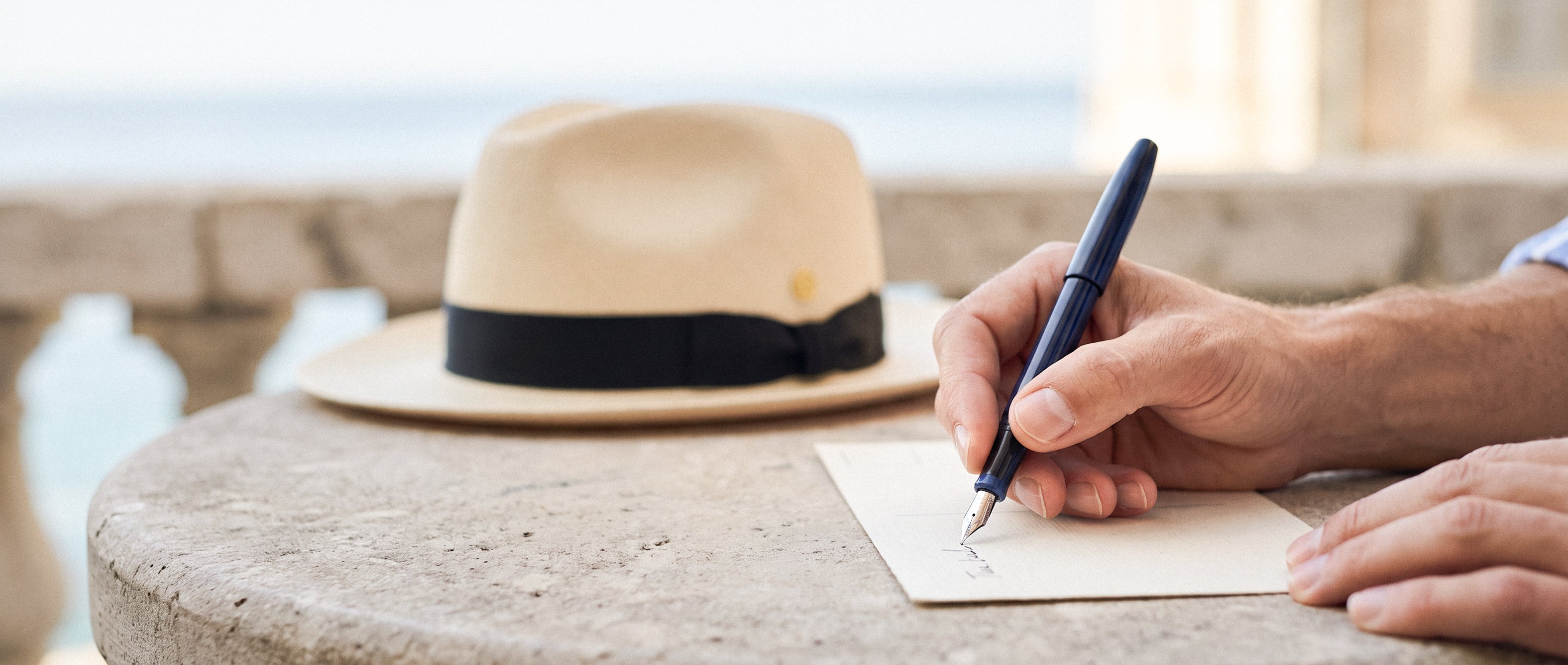
What is a Borsalino hat? It is a felt hat made by Borsalino, the Italian hatmaker founded in Alessandria, Piedmont, in 1857 and still working there today. In everyday use the word means one thing: a fur felt fedora with a creased crown, a pinched front and a soft brim that can be snapped down. Since 1911, JJ Hat Center has been fitting New Yorkers with hats like these, and Borsalino is one of the few names people walk in already knowing.
What Is a Borsalino Hat, Exactly?
Strictly speaking, a Borsalino hat is any hat made by the Borsalino company. In practice the name describes both a shape and a standard of make: a soft brimmed hat in fine fur felt, light in the hand, firm in the crown, and finished so cleanly that you have to look for the seam in the sweatband.
The felt is the starting point. Borsalino hats are built from rabbit fur felt rather than wool, and the difference is easy to feel: fur felt is denser, lighter for its stiffness, far more water resistant and much better at holding a crease. A wool felt hat goes limp when the weather turns; a good fur felt hat keeps its shape through a wet walk to the subway. The higher grades add beaver or a longer, finer fiber, which is where most of the price spread across fur felt hats comes from.
Borsalino hats are also unusually light for their firmness — the finer the fiber and the more patiently it is worked, the less material a given stiffness needs.
A Piedmont Workshop Since 1857
Giuseppe Borsalino opened his workshop in Alessandria in 1857 after learning the trade as a hatter in France. Within a generation the company was shipping Italian felt hats across Europe and the Americas, and the family name became shorthand for the fedora itself. In Italy and France people still say a Borsalino much the way Americans once said a Stetson.
The making has never been shortened much. A hat body passes through more than fifty separate operations — felting, shrinking, blocking, sanding, ironing, trimming, hand-stitching the sweatband and ribbon — spread over several weeks of workshop time. Most of it is manual, and nearly all of it exists to make the felt behave predictably for decades. Our guide to how a premium hat is made walks through the same stages.
The Borsalino Fedora: The Shape Most People Mean
When someone asks about a Borsalino fedora, they usually have the classic in mind: a teardrop or center-dent crown, a front pinch you can set with two fingers, and a brim of roughly two to two and a half inches (about 5 to 6 cm) that snaps down in front and stays up at the back.
Borsalino fedora hats vary far more than that description suggests. Brim widths run from a narrow city brim to a wide, deliberate sweep; crowns from the low, modern profile to the taller blocks of the 1930s; trims from plain grosgrain to leather, feather and knotted silk. As a rule, the narrower the brim, the more contemporary the hat reads; the wider it gets, the more it asks of the rest of the outfit. For the mechanics of wearing one, see how to wear a fedora, and compare the shapes we stock in fedora hats.
Beyond the Fedora
Borsalino is not only a fedora maker. The range takes in trilbies with a shorter brim and sharper taper, straw and panama shapes for summer, packable travel felts that recover their form after being rolled, flat caps and the occasional bowler — all sharing one family trait: a light body and a crown that takes a crease and keeps it.
How Much Does a Borsalino Hat Cost?
Borsalino sits at the top of the felt hat market. Expect a new one to run into several hundred dollars, with wide brims, limited fur blends and hand-finished models climbing well beyond that. There is no budget tier in the range: the price reflects the grade of the fiber, the weeks of work and the finishing.
The useful way to read a Borsalino price is per year of wear rather than per receipt. A fur felt hat that is brushed, rested properly and reblocked once or twice stays in service for decades — unlike a wool hat that is tired after two winters. Current pricing and the shapes we carry are in our Borsalino collection.
Where Borsalino Fits in a New York Hat Shop
JJ Hat Center, a New York hat shop since 1911, has watched several generations of hat wearers come through the door, and the Borsalino has held its place throughout. It ranks third among the hat brands we sell — but it draws a noticeably larger share of shopper attention than it does of actual buying. People read about the name and think about it for months before they try one on.
That makes sense once you have handled one: a Borsalino is a considered hat, not an impulse. It also sits in the part of our range that has been leading lately — over the past season, brimmed hats have run ahead of caps in our mix. To see the Italian side of the store in one place, start with An Icon of Italian Style: Borsalino.
How to Tell a Genuine Borsalino
Look inside first. A genuine hat carries the Borsalino mark on the interior lining and the size stamped on or beside the sweatband. The sweatband itself is leather, stitched rather than glued, and it sits flat without ripples. The felt should feel dense, smooth and cool to the touch, not fuzzy or papery, and the brim edge finished evenly all the way around.
Weight is the other giveaway: fine fur felt feels lighter than it looks, and the crown springs back when pressed gently. The simplest safeguard, though, is where you buy — an established hat retailer that buys directly from the maker, not an unvetted marketplace listing.
Getting the Size and Fit Right
American hats are sized in eighths of an inch — 6 7/8, 7, 7 1/8, 7 1/4 and upward. Run a soft tape around your head, level, just above the ears and across the widest point at the back of the skull, then match it against the size chart. Borsalino also prints a European size inside, so a hat may show two numbers — use the one matching the chart you measured against.
The fit should be snug without pressing. A hat that leaves a red line on your forehead is too small; one that shifts when you turn your head quickly is too big. If you land between sizes, take the larger and add a sizing strip under the sweatband — a five-minute adjustment, where a hat that is truly too small never becomes comfortable.
Caring for a Borsalino
Fur felt rewards a little routine attention.
- Brush after wearing. Use a soft-bristle hat brush and work counterclockwise around the crown and brim so the nap lies in one direction.
- Handle it by the brim. Lift the hat front and back; pinching the crown is what wears the crease through over time.
- Rest it upside down. Set it on its crown or a hat stand, never on the brim.
- Dry it slowly. If it gets soaked, shake off the water, reset the crease with your fingers and let it dry at room temperature, away from radiators and hot air — heat is what makes fur felt brittle.
- Store it boxed. Between seasons, keep it in a hat box, out of direct sunlight.
Frequently Asked Questions
What is a Borsalino hat made of?
Most Borsalino hats are made of rabbit fur felt, with the higher grades adding beaver or longer, finer fibers. The company also makes straw and fabric hats for summer, plus woven and knitted caps.
Is a Borsalino the same as a fedora?
No. Borsalino is a maker; a fedora is a shape. Because the company has made so many fedoras for so long, the two words often get used interchangeably, but Borsalino also makes trilbies, flat caps, straw hats and bowlers.
Why are Borsalino hats expensive?
The price comes from the fiber and the labor: fine rabbit fur felt, more than fifty separate operations on every hat body, and several weeks of workshop time, most of it handwork.
How long does a Borsalino hat last?
A fur felt Borsalino that is brushed regularly, rested off its brim and kept away from heat can be worn for decades. The sweatband and ribbon can be replaced, and a tired crown can be reblocked.
What size Borsalino hat should I buy?
Measure the circumference of your head just above the ears and match it to a US size in eighths of an inch. If you fall between sizes, take the larger one and add a sizing strip; Borsalino stamps the European size inside as well.