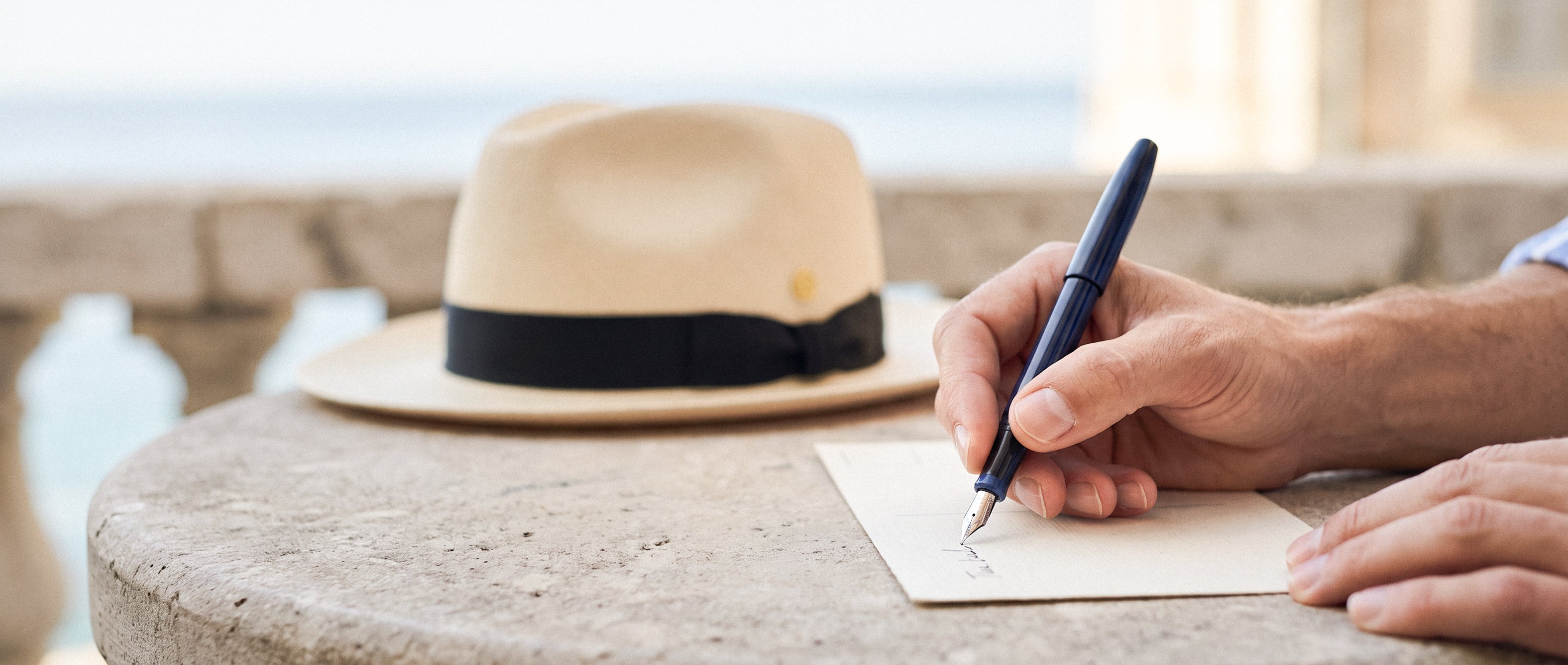
How should a fedora hat fit? Snug the whole way around, level on your head, and low enough that the brim clears the tops of your ears by about a finger's width. A correctly sized fedora stays put when you turn your head, leaves no red line across your forehead after a quarter of an hour, and rests on the widest part of your skull instead of perching on top of it. Since 1911, JJ Hat Center has been fitting hats in New York, and nearly every fit problem that walks through our door comes down to one of two things: a head that was never measured, or a size letter that meant something different at a different maker.
How Should a Fedora Hat Fit? Three Checks in the Mirror
Three checks catch nearly every sizing error. Run all of them with the hat on, before you decide anything about style.
- Pressure. Wear the hat for ten to fifteen minutes, then take it off and look at your forehead and the skin above your ears. Clean skin means the size is right. A red indentation means the hat is a size too small — not that it needs breaking in.
- Position. The brim should cross your forehead roughly level with your eyebrows and clear the tops of your ears by about a finger's width. If the brim rides high and the hat looks balanced on top of your head rather than wrapped around it, the size is too small. If the brim drops toward your eyebrows and the crown settles until it touches your ears, it is too big.
- Movement. Walk a few steps, turn your head left and right, then look down at the floor. A fedora that fits moves with you. One that rotates out of line or slides forward when you look down is too large, and it will leave your head in the first gust on a cross street.
All three checks test the same thing: whether the sweatband sits in full contact with your head around its entire circumference. The sweatband carries the hat — not the crown, not the brim. When a fedora feels unstable, it is usually because the band touches at the front and back and leaves a gap at the sides, or the reverse.
How to Measure Your Head for a Hat
Use a flexible tailor's tape and measure where the hat will actually sit: about an eighth of an inch above your ears, across the middle of your forehead, and around the small bony ridge at the back of your skull. Keep the tape level the whole way around. A tape that slides down at the back reads short and sends you one size too small.
Pull the tape snug, the way a sweatband rests, not tight the way a belt does. Measure three times and keep the largest reading — heads are not perfectly round, and the largest honest number is the one the hat has to accommodate. Wear your hair the way you normally wear it, because a quarter inch of volume matters at the top of the size range.
No tape at home? Run a shoelace or a strip of ribbon around your head along the same path, mark where the ends meet, and lay it flat against a ruler. Work in inches first, because US hat sizes are built from inches.
US Hat Sizes: Reading the Numbers from 6 7/8 to 8
A US hat size is not an arbitrary label. It is the circumference of your head in inches divided by pi, roughly 3.14, which means a tape measure converts in both directions. A head that comes in just under twenty-three inches is a 7 1/4; a head of twenty-four and three-eighths inches is a 7 3/4. That is also why numbered sizes climb in eighths: one eighth of a hat size is just under half an inch of head.
| US hat size | Head circumference (inches) | Letter size (varies by maker) |
|---|---|---|
| 6 7/8 | twenty-one and five-eighths | X-Small |
| 7 | twenty-two | Small |
| 7 1/8 | twenty-two and three-eighths | Small / Medium |
| 7 1/4 | twenty-two and three-quarters | Medium |
| 7 3/8 | twenty-three and one-eighth | Medium / Large |
| 7 1/2 | twenty-three and a half | Large |
| 7 5/8 | twenty-four | X-Large |
| 7 3/4 | twenty-four and three-eighths | X-Large or XX-Large |
| 7 7/8 | twenty-four and three-quarters | XX-Large |
| 8 | twenty-five and one-eighth | XX-Large or larger |
Working from a metric tape? Multiply the hat size by eight and take a few millimeters back off: a 7 3/4 head lands a shade under sixty-two centimeters. And when your reading falls exactly between two sizes, take the larger one and read the section on sizing strips below.
Why Small, Medium, and Large Disagree from Maker to Maker
Numbered sizes are arithmetic. Letter sizes are a decision made in a design studio, and the studios do not agree. One house starts its Large at 7 1/2, the next at 7 3/8, and at 7 3/4 the disagreement turns practical: some makers list that head as their X-Large, others as the bottom of their XX-Large. Trust the inch or centimeter figure on a size chart and treat the letter as a rough hint. When a listing gives you only a letter, ask for the number before you buy.
Why a Cap and a Fedora in the Same Stated Size Fit Differently
Caps are the best-selling category at JJ Hat Center, just ahead of hats, so this question reaches us almost daily. A fedora is built around a leather or grosgrain sweatband that follows a fixed oval: the size it states is the size it is. A flat cap or newsboy has a soft lining, seam allowance that gives, and a crown that can absorb an extra eighth of an inch of head without complaint. The same 7 1/4 therefore reads tight in a stiff fur felt fedora and comfortable in a wool newsboy.
Two consequences follow. If you fall between sizes, the cap is the forgiving purchase and the fedora is the one to measure for. And a cap sized in letter bands hides a far wider range of heads than a numbered fedora does, which is why the letter alone tells you so little. Our guide to choosing between a Stetson flat cap and a newsboy cap covers how the two silhouettes carry volume differently.
Felt Moves: What Changes in the First Few Weeks
Fur felt and wool felt are pressed, not woven, so they relax a little with body heat and wear. "A little" is the operative phrase: expect roughly a quarter of a size of give over a season of regular wear, not a full size. A fedora that pinches in October will still pinch in March.
Humidity works in both directions. Damp summer air swells both the felt and the sweatband, so a hat that was right in January can feel close in July; dry winter air does the reverse. That is one reason we fit for snug-but-unmarked instead of tight. A fit with no margin at all has nowhere to go when the weather turns. What felt will never do is shrink back a size because you hoped it would, so buying one size up and waiting for it to tighten is the most expensive sizing mistake in hats.
What to Do When You Fall Between Two Sizes
Round up, then fill the gap. A hat that runs slightly large can be brought down by up to about half a size with sizing material tucked behind the sweatband. A hat that runs slightly small cannot be opened up by more than a hair, and stretching a finished felt crown risks distorting the shape it was blocked into.
The quiet proof of how common this is sits at the top of our own ranking: cork sizing strips are the single most-requested item in the store, ahead of every hat, cap, and beanie we stock by a clear margin. Use them in thin layers, start at the front and sides where the gap actually shows rather than at the back, and run the three mirror checks again after each layer. If the hat you already own has drifted out of fit, our guide to what to do when your hat feels too tight or too loose covers the repairs that work and the ones that ruin a crown.
Head Sizes 7 3/4 and Up: Finding a Fedora That Actually Fits
Above 7 5/8 the problem changes character. It stops being a question of which style you want and becomes a question of who blocks the size at all. Large heads need their own blocks, longer sweatbands, and bigger felt bodies, which means a separate production run — so most of the market simply stops at 7 1/2 or 7 5/8 and leaves the rest of us to hunt.
At JJ Hat Center the large sizes are an aisle, not an afterthought, and because the makers we carry disagree on the letter, the same head size is filed two ways: 7 3/4 listed as X-Large and 7 3/4 listed as XX-Large. Browse both: the number is what matters, and a hat that fits is easy to miss when it has been shelved under the other letter.
Proportion at the Top of the Size Range
A larger head needs a larger hat in two dimensions, not one. Put a 7 3/4 head under a stingy brim — anything under two inches — and the crown reads as a wide block sitting on a narrow shelf. The proportional fix is a brim in the range of 2 1/4 to 2 3/4 inches and a crown tall enough to carry the width, which is why classic dress shapes tend to suit big heads better than cropped modern ones. A center dent or a teardrop crease also narrows the crown visually, whereas a flat, untouched crown widens it. Those are the shapes to look for first in our fedora collection.
One more mechanical point: the taller the crown and the wider the brim, the more leverage the wind has. At the top of the size range, fit precision matters more, not less — a 7 3/4 hat that is an eighth loose behaves far worse in a January crosswind than a 7 1/8 does.
Oversized vs. Oversize: Two Words That Mean Different Things
Search for an oversized beanie and you will get two unrelated kinds of result, and the difference is worth understanding before you spend money. Oversize is a size: headwear cut for a head of 7 3/4 or larger. Oversized is usually a silhouette: a knit deliberately longer and roomier than the head inside it, so it slouches at the back. A slim 7 1/8 head can wear an oversized beanie. A 7 7/8 head needs an oversize one. A few pieces are both, and the listing rarely tells you which.
Oversized Beanies and the Slouchy Profile
An oversized beanie profile comes from extra length in the body of the knit, not from a wider ribbed band. Pull the hat down to the brow and the surplus gathers behind the crown; fold the band twice instead and the same beanie reads neat and close.
A Men's Slouchy Beanie in a Large Size
A men's slouchy beanie in a large size has to clear both hurdles at once: enough stretch in the rib to sit on a big head without pressure, and enough body length for the slouch to look deliberate rather than like a hat that does not fit. Fine-gauge merino and cashmere blends hold a slouch better than bulky acrylic, which collapses flat under its own weight. Beanies and trapper hats rank third among our categories, behind caps and hats, and the knits cut for genuinely large heads — rather than merely cut long — are gathered in our oversize beanies collection.
The Oversized Newsboy Hat: Volume That Is Cut In
The two meanings collide again in caps. An oversized newsboy hat is not automatically a big-head cap — it is a newsboy whose panels are cut full, so the crown puffs generously over the peak. That fullness is a style decision made at the pattern stage, and it does nothing for circumference: a generously cut newsboy in a 7 1/4 still measures 7 1/4 at the band. A herringbone newsboy with ear flaps ranks inside our ten best-performing items overall, and its appeal is exactly this combination of full crown and precise band. If you need both the full cut and a large head size, check the stated number on the specific cap rather than trusting the silhouette, and start from our newsboy caps.
Frequently Asked Questions
How tight should a fedora be?
Snug enough that it does not shift when you turn your head, loose enough to leave no mark on your forehead after fifteen minutes. If you can work a fingertip between the sweatband and your temple against mild resistance, the size is right.
How far down should a fedora sit on your head?
The brim should cross your forehead about level with your eyebrows and clear the tops of your ears by roughly a finger's width. A fedora resting on your ears is too large; one sitting visibly above the brow line is too small.
Do felt fedoras stretch over time?
Slightly — on the order of a quarter of a size over a season of regular wear, and more in humid weather than in dry. Never buy a size down expecting felt to stretch into it, because the give is far smaller than a full size.
Is 7 3/4 an X-Large or an XX-Large?
Both, depending on the maker. A 7 3/4 is twenty-four and three-eighths inches of head circumference, a shade under sixty-two centimeters; some houses call that their X-Large and others the start of their XX-Large. JJ Hat Center lists 7 3/4 under both letters so the hat is findable either way.
Is an oversized beanie the same as a large-size beanie?
No. Oversized describes the cut — extra length for a slouchy profile — while oversize describes the head it was made for. Check the stated size range, not the drape in the photograph.